
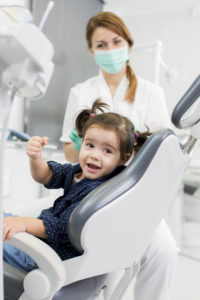
 If you’ve ever tried to take a child to the dentist, you know just how difficult and stressful it can be. Just imagine not knowing what’s going to happen, the sights, sounds, and smells, it can be easily overwhelming.
Advances in sedation dentistry has helped children who are fearful and anxious about dental procedures to get the oral health treatment they need. A study by the Center or Disease Control and Prevention, shows an increase in the number of younger children requiring extensive dental work. Nationwide dentist have noticed a high number of preschoolers with 6 to 10 cavities. Since most children are not able to sit through extensive procedures, sedation is recommended.
National Library of Medicine recently published an article about sedation techniques in pediatric dentistry.
Children and adolescents who suffer from odontophobia or dental anxiety may exhibit disruptive behaviors during examinations and treatment, ranging from restlessness to full-blown tantrums; In the most extreme cases, young individuals with dental anxiety may refuse treatment, even when they are experiencing significant pain that could be relieved with proper care
As per the American Academy of Pediatric Dentistry (AAPD) and the American Association of Pediatrics (AAP),the objectives of sedation encompass:
to guard the patient’s safety and welfare;
to minimize physical discomfort and pain;
control anxiety, minimize psychological trauma, and maximize the potential for amnesia;
to modify behavior and/or movement to allow the safe completion of the procedure; and
to return the patient to a state in which discharge from medical/dental supervision is safe, as determined by recognized criterial.
All of these objectives must be attained while ensuring that the patient retains airway control, oxygenation, and hemodynamic stability.
Over the last three decades, sedation has become a commonly used alternative to general anesthesia. However, it is worth noting that almost 80% of sedation-related emergencies initially present as respiratory compromise. As the level of sedation deepens, the airway protective reflex decreases, and the likelihood of airway obstruction or foreign body aspiration increases. Therefore, appropriate respiratory monitoring and airway management are essential during sedation procedures.
Make Sure Your Child Is Safe At The Dentist
To ensure safety is the top priority during your child’s dentist appointment, it is critical to have a a certified third party to continuously monitor the patient during and after the procedure. Appropriate airway management and respiratory monitoring is paramount during dental IV sedation.
You are in great hands at Blue Sky Anesthesia Associates , we bring hospital level sedation to your dental office. We are proud to partner with dentist throughout New Hampshire, Maine, and Vermont
Contact Blue Sky Anesthesia Associates for more information.

